5 min read · Last updated November 25, 2026
How to sell on ChatGPT, Muse and other AI shopping agents
AI apps like ChatGPT, Muse, Gemini and Copilot now find and sell products. Get your store in through your platform, AI merchant programs and the open web
Who this is for
Who should read this
- Store owner or founder
- Which AI apps can sell your products, and what it costs
- Ecommerce or marketing manager
- How to get your catalog into each app, and how to see the sales
- Web or IT lead
- What AI agents need to read and reach your store
Can you sell on ChatGPT?
Yes. If you sell on Shopify or Etsy, your products are already connected to ChatGPT, with no setup or application. Other stores can apply to send their catalog. ChatGPT charges no fee on sales that start there, and the shopper pays on your site
ChatGPT is one of several AI apps that now shop for people. Google Gemini, Microsoft Copilot, Meta's Muse and Perplexity all recommend products, and some buy them for the shopper
How do AI apps find your products?
There are three ways in, and they add up. The more of them you use, the more often AI apps can show and sell your products
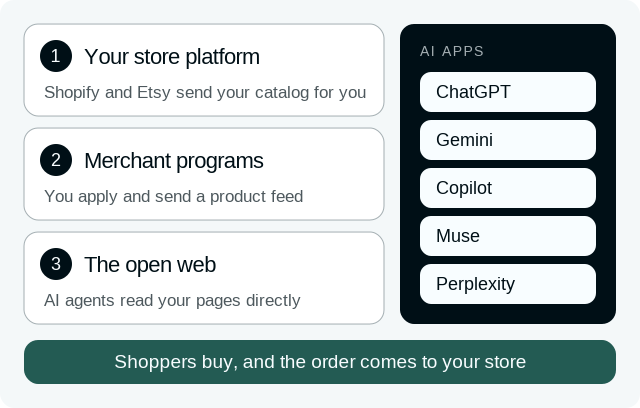
Which AI apps can sell your products?
Each app gets products in its own way, and the shopper pays in a different place
| AI app | How your products get in | Where the shopper pays |
|---|---|---|
| ChatGPT | Shopify and Etsy automatically; other stores apply with a product feed | On your site |
| Google AI Mode and Gemini | Google Merchant Center, or Shopify's AI channels | In Google for selected stores, otherwise on your site |
| Microsoft Copilot | Shopify automatically; other stores through Microsoft Merchant Center | In Copilot, for US shoppers |
| Meta Muse | Shopify's catalog, partner retailers, and visits to your site | Muse fills in your checkout, after the shopper approves |
| Perplexity | Stores connected through PayPal, including many on BigCommerce and Wix | In Perplexity with PayPal, for US shoppers |
In every case the order comes to you, and you ship it
How do you get in on Shopify?
Shopify stores are in by default. Shopify calls this Agentic storefronts, and it's on for eligible stores without you doing anything
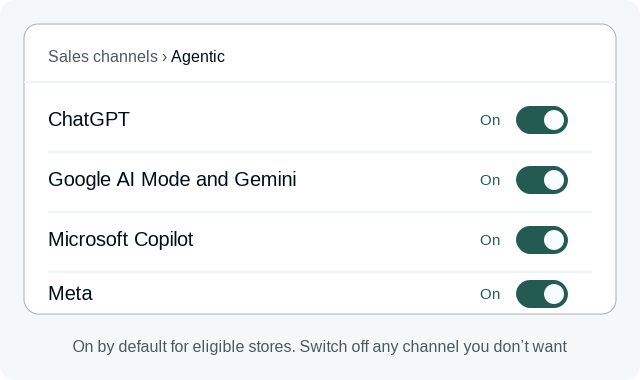
- Open the setting. In your Shopify admin, go to Sales channels, then Agentic.
- Check you're eligible. Your products need to qualify for Shopify Catalog, and your store needs terms of service, a privacy policy and a refund policy.
- Pick your apps. Leave on the AI apps you want to sell in, and switch off any you don't.
- Decide on checkout. For Google, Copilot and Meta, you can let shoppers pay inside the AI app. ChatGPT shoppers pay on your store's own checkout.
Shopify charges no extra fee for selling in ChatGPT, only your normal payment processing
How do you get in on other platforms?
Outside Shopify, you apply to each AI company, and some platforms connect you for you
- Etsy: your listings are already in ChatGPT.
- Any store: apply to send your product feed at chatgpt.com/merchants. New applicants join a waitlist.
- Google: list your products in Google Merchant Center. Paying inside Google is open to selected stores.
- Microsoft: set up Microsoft Merchant Center to sell in Copilot.
- Wix: AI shopping through PayPal and Stripe is rolling out, and eligible stores are added automatically.
- BigCommerce: many stores already sell in Perplexity through PayPal.
- WooCommerce: AI checkout is in a pilot, so for now use the merchant programs above.
How do you make sure AI agents can reach your store?
Even with a feed, AI apps still visit your pages to check price and stock, and agents like Muse fill in your checkout themselves. Three checks keep that working:
- Let AI search crawlers in. ChatGPT, for example, leaves out sites that block its search crawler, OAI-SearchBot. Run the free robots.txt checker.
- Show price, sizes and stock as text. Agents read words, not pictures.
- Keep checkout clear. CAPTCHAs on add to cart, pop-ups over the buy button and forced sign-up stop agents the same way they stop people.
How do you see what AI sells for you?
Start with your orders and analytics. Shopify marks orders that come through AI apps, and shoppers who click from ChatGPT show in analytics as visits from chatgpt.com
Agents that browse for the shopper are harder to see. Many don't run your analytics, and some look like a normal Chrome visitor. The measurement guide covers how to count them
DNA by D3 shows which shopping agents read your product pages and whether each one is real. You can see that the open-web path is working, and fakes that copy a famous agent's name stay out
Next for you: How AI shopping agents find and buy from your store
Questions
Does it cost anything to sell on ChatGPT?
No. ChatGPT charges no fee on purchases that start there. You pay only your normal payment processing
Do I keep the customer?
Yes. On ChatGPT the shopper buys on your site. When shoppers pay inside Google or Copilot, you stay the seller, and the order and customer details come to you
Do I need a product feed?
Not on Shopify or Etsy, where your platform shares your catalog. Other stores need one for merchant programs, but AI apps can still find your products by reading your pages
Which AI apps let shoppers pay without leaving the app?
Copilot and Perplexity for US shoppers, and Google for selected stores. ChatGPT sends shoppers to your site to pay
Can I sell on Muse?
Yes. Muse shops Shopify's catalog and visits other stores directly, so a store it can read and check out on can sell to Muse shoppers. The Muse guide explains how
Sources
- Shopping in ChatGPT for merchants, OpenAI
- Overview of OpenAI crawlers, OpenAI
- Agentic storefronts and Selling in ChatGPT, Shopify Help Center
- UCP-powered checkout, Google Merchant Center Help
- Agentic commerce, Microsoft Advertising
- What is Instant Buy?, Perplexity Help Center
- Introducing Muse, Meta, Sept 2026
- Agentic commerce on Wix, Wix, Oct 2026
- Agentic commerce and payments, WooCommerce, Nov 19, 2026