4 min read · Last updated November 24, 2026
What is Meta's Muse? How a personal agent shops your store
Muse is Meta's personal AI agent. People ask it to find and buy things, and it shops online stores for them in its own browser, with their approval. To your store, a Muse visit looks like a normal Chrome visitor, which makes it easy to miss and easy to fake
Who this is for
Who should read this
- Store owner or founder
- What Muse is, and whether it can buy from your store
- Ecommerce or marketing manager
- How Muse finds products and pays
- Web or IT lead
- Why a Muse visit is hard to spot, and what to check
What is Meta's Muse?
Muse is a personal AI agent made by Meta, the company behind Facebook, Instagram and WhatsApp. A chatbot answers questions. Muse does tasks: you tell it what you want, and it browses the web, compares options and buys for you
People use Muse in its app, at muse.ai, inside WhatsApp, or as a Chrome extension. Shopping is what they use it for most. Meta says more than 10 million people in the US and Canada set up Muse in its first six weeks, more than a quarter of them shop with it, and the average purchase is over $200, travel included
How does Muse shop?
Muse shops in four steps: it finds a product, opens the store, fills the checkout, and asks its user to approve before paying
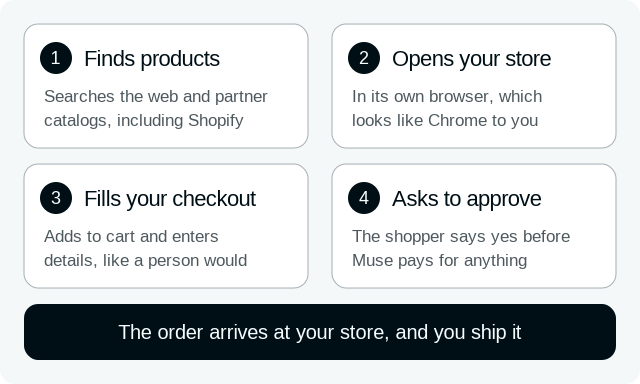
To find products, Muse searches the web and catalogs it's connected to. Shopify stores are included automatically through Shopify's own catalog, and Meta works directly with some large retailers
To pay, Muse uses a one-time card number from Link by Stripe, or signs in to the shopper's account on your store and uses their saved card. Either way, the order comes to you like any other, and you ship it
Can Muse buy from my store?
Usually, yes, as long as Muse can read your product pages and get through your checkout. What stops it is the same stuff that annoys people: CAPTCHAs, pop-ups over the buy button, forced account sign-up, and prices shown only in images
Shopify stores get an extra option. Checkout can happen inside Meta's app, and it's on by default for eligible stores. Those orders are labelled "Meta AI and Muse", Meta charges no fee, and you can turn it off in Shopify under Sales channels, then Agentic
How can you tell if Muse visited your store?
Mostly, you can't. Muse doesn't announce itself, so its visits look like a regular person using Chrome. When we sent Muse to a test page, it arrived twice as Chrome with no name at all (D3 research)
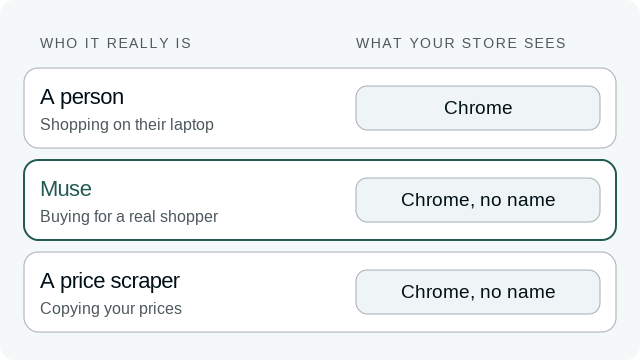
Other big AI companies give their agents a name and publish a list you can check them against. OpenAI does this for ChatGPT-User. Meta does neither for Muse
| ChatGPT-User | Muse | |
|---|---|---|
| Says its name | Yes | No |
| Can be checked | Yes | No |
That leaves stores stuck. Block every unnamed Chrome visit and you turn away Muse's shoppers, and real people with them. Let them all in and price scrapers in the same disguise get in too
DNA by D3 closes that gap. Its browser check spots an agent driving Chrome even when it gives no name, as it did with Muse in our test. Turn on a verify policy and a Muse shopper confirms once, free, while a scraper in the same disguise stays out
What should store owners do?
Four quick checks, none of them needs a developer:
- Test it. Ask Muse to buy something from your store, then decline when it asks for approval. Note anywhere it got stuck.
- Clear the blocks. Remove CAPTCHAs on add to cart, pop-ups over the buy button and forced sign-up.
- Use text, not just images. Show price, sizes and stock in words Muse can read.
- Check your robots.txt. Muse has no rule of its own, but the AI search crawlers that send you shoppers do. Run the free robots.txt checker.
Next for you: How AI shopping agents find and buy from your store
Questions
Is Meta's Muse free?
Yes, there's a free version. Where available, paid plans cost $20 a month (Power) and $100 a month (Max)
Does Muse follow robots.txt?
Meta hasn't said, and there's no robots.txt rule just for Muse. Meta's other crawlers, such as Meta-ExternalAgent, do have their own rules
Can I block Muse?
Not by name, because it doesn't send one. Blocking every unnamed Chrome visit would block real customers too
Does Muse show up in Google Analytics?
Its visits can look like normal visitors, because Muse uses a real browser. Shopify orders placed inside Meta's app don't show in Google Analytics, but Shopify labels them "Meta AI and Muse"
Sources
- AI agents now shop your Shopify store. Until checkout, you can’t tell whose., D3 research, Nov 2026
- Introducing Muse, Meta, Sept 8, 2026
- Q3 2026 earnings call transcript, Meta, Oct 21, 2026
- Muse is now available in the UK, Meta, Nov 23, 2026
- Paying with Muse and Muse subscriptions, Meta Help Center
- Meta web crawlers, Meta for Developers
- Overview of OpenAI crawlers, OpenAI
- Meta AI and Muse, Shopify Help Center